Sunday, November 12, 2006
The Melancholic
Dissimulation, secretiveness appear a necessity to the melancholic. He has complex, often veiled relations with others. These feelings of superiority, of inadequacy, of baffled feeling, of not being able to get what one wants, or even name it properly (or consistently) to oneself--these can be, it is felt they ought to be, masked by friendliness, or the most scrupulous manipulation.Susan Sontag - Under the Sign of Saturn


Monday, November 06, 2006
Nothing Lasts
Melancholy is at the bottom of everything, just as at the end of all rivers is the sea. Can it be otherwise in a world where nothing lasts, where all that we have loved or shall love must die? Is death, then, the secret of life? The gloom of an eternal mourning enwraps, more or less closely, every serious and thoughtful soul, as night enwraps the universe. - Henri Frederic Amiel
Friday, October 27, 2006
The Church of the Non-Believers
MY FRIENDS, I MUST ASK YOU AN IMPORTANT QUESTION TODAY: Where do you stand on God?
It's a question you may prefer not to be asked. But I'm afraid I have no choice. We find ourselves, this very autumn, three and a half centuries after the intellectual martyrdom of Galileo, caught up in a struggle of ultimate importance, when each one of us must make a commitment. It is time to declare our position.
This is the challenge posed by the New Atheists. We are called upon, we lax agnostics, we noncommittal nonbelievers, we vague deists who would be embarrassed to defend antique absurdities like the Virgin Birth or the notion that Mary rose into heaven without dying, or any other blatant myth; we are called out, we fence-sitters, and told to help exorcise this debilitating curse: the curse of faith.
The New Atheists will not let us off the hook simply because we are not doctrinaire believers. They condemn not just belief in God but respect for belief in God. Religion is not only wrong; it's evil. Now that the battle has been joined, there's no excuse for shirking.
Three writers have sounded this call to arms. They are Richard Dawkins, Sam Harris, and Daniel Dennett. A few months ago, I set out to talk with them. I wanted to find out what it would mean to enlist in the war against faith...more here
It's a question you may prefer not to be asked. But I'm afraid I have no choice. We find ourselves, this very autumn, three and a half centuries after the intellectual martyrdom of Galileo, caught up in a struggle of ultimate importance, when each one of us must make a commitment. It is time to declare our position.
This is the challenge posed by the New Atheists. We are called upon, we lax agnostics, we noncommittal nonbelievers, we vague deists who would be embarrassed to defend antique absurdities like the Virgin Birth or the notion that Mary rose into heaven without dying, or any other blatant myth; we are called out, we fence-sitters, and told to help exorcise this debilitating curse: the curse of faith.
The New Atheists will not let us off the hook simply because we are not doctrinaire believers. They condemn not just belief in God but respect for belief in God. Religion is not only wrong; it's evil. Now that the battle has been joined, there's no excuse for shirking.
Three writers have sounded this call to arms. They are Richard Dawkins, Sam Harris, and Daniel Dennett. A few months ago, I set out to talk with them. I wanted to find out what it would mean to enlist in the war against faith...more here
Saturday, October 07, 2006
In Time
We need be careful how we deal with those about us, when every death carries to some small circle of survivors, thoughts of so much omitted, so little done -- of so many things forgotten, and so many more which might have been repaired! There is no remorse so deep, as that which is unavailing; if we would be spared its tortures, let us remember this, in time.Charles Dickens, Oliver Twist, chap. 33
Sunday, October 01, 2006
The End of the World As They Know It
What do Christian millenarians, jihadists, Ivy League professors, and baby-boomers have in common? They’re all hot for the apocalypse...more here
A Metaphysical Materialist
Who was the real Walter Benjamin? Was it the otherworldly aesthete who believed, along with the German Romantics, that literature has a redemptive purpose, and who was indifferent to whether a literary work was actually read, since it is ultimately a metaphysical end in itself?
Or was the real Benjamin the self-proclaimed "strategist in the literary struggle," the follower of Bertolt Brecht who, during the 1920s and '30s, became enamored of Soviet literature and film, with their odes to factory work and agricultural collectivization, dismissing art for art's sake as an unconscionable bourgeois indulgence in an age of class struggle?
Or was it the passionate Kabbalist, the friend of Gershom Scholem who proclaimed that his interpretive ideal was the Talmudic doctrine according to which every Torah passage contained forty-nine levels of meaning; who pronounced, without a trace of irony, that any philosophy that could not foretell the future by reading coffee grounds was worthless; who, following the fall of France in 1940, argued that Marxism could prevail only if it enlisted the help of theology; and who claimed that the goal of revolution was not so much the emancipation of future generations as the resurrection of vanquished ancestors? ...more here
Or was the real Benjamin the self-proclaimed "strategist in the literary struggle," the follower of Bertolt Brecht who, during the 1920s and '30s, became enamored of Soviet literature and film, with their odes to factory work and agricultural collectivization, dismissing art for art's sake as an unconscionable bourgeois indulgence in an age of class struggle?
Or was it the passionate Kabbalist, the friend of Gershom Scholem who proclaimed that his interpretive ideal was the Talmudic doctrine according to which every Torah passage contained forty-nine levels of meaning; who pronounced, without a trace of irony, that any philosophy that could not foretell the future by reading coffee grounds was worthless; who, following the fall of France in 1940, argued that Marxism could prevail only if it enlisted the help of theology; and who claimed that the goal of revolution was not so much the emancipation of future generations as the resurrection of vanquished ancestors? ...more here
Friday, September 15, 2006
Melancholy
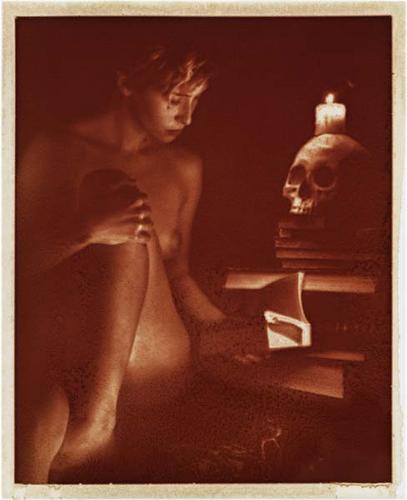
Melancholy is the pleasure of being sad.
- Victor Hugo
Melancholy sees the worst of things,--things as they may be, and not as they are. It looks upon a beautiful face, and sees but a grinning skull.
- Christian Nestell Bovee
Here rests his head upon the lap of earth,
A youth, to fortune and to fame unknown;
Fair Science frowned not on his humble birth,
And Melancholy marked him for her own.
- Thomas Gray,
Elegy in a Country Churchyard--The Epitaph
Hence, all you vain delights,
As short as are the nights
Wherein you spend your folly!
There's nought in this life sweet,
If man were wise to see 't,
But only melancholy,
Oh, sweetest melancholy!
- Dr. William Strode, Song in Praise of Melancholy,
as given in Malone's Manuscripts in the Bodleian Library, manuscript no. 21
Wednesday, September 06, 2006
Quotes related to books, reading
Anyone who has a book collection wants for nothing.
--CiceroBooks are carriers of civilization. Without books, history is silent, literature dumb, science crippled, thought and speculations at a standstill.
--Barbara TuchmanIt is not true that we have only one life to live; if we can read, we can live as many more lives and as many kinds of lives as we wish.
--S.I. HiyakawaThere are worse crimes than burning books. One of them is not reading them.
--Joseph Brodsky (1940-1996)The book must of necessity be put into a bookcase. And the bookcase must be housed. And the house must be kept. And the library must be dusted, must be arranged, must be catalogued. What a vista of toil, yet not unhappy toil!
--William GladstoneRead in order to Live.
--Gustave Flaubert
--CiceroBooks are carriers of civilization. Without books, history is silent, literature dumb, science crippled, thought and speculations at a standstill.
--Barbara TuchmanIt is not true that we have only one life to live; if we can read, we can live as many more lives and as many kinds of lives as we wish.
--S.I. HiyakawaThere are worse crimes than burning books. One of them is not reading them.
--Joseph Brodsky (1940-1996)The book must of necessity be put into a bookcase. And the bookcase must be housed. And the house must be kept. And the library must be dusted, must be arranged, must be catalogued. What a vista of toil, yet not unhappy toil!
--William GladstoneRead in order to Live.
--Gustave Flaubert
Monday, September 04, 2006
Sunday, September 03, 2006
20 Things You Didn't Know About... Death
Newsflash: we're all going to die. But here are 20 things you didn't know about kicking the bucket...more here
Wednesday, August 23, 2006
Currently Reading

Walter Benjamin: Selected Writings: Part 2 1931-1934
Tuesday, August 22, 2006
Why Booksellers Are Going Belly Up
Balloons, sky-blue and gold and arterial red, bobbed against Cody's glass facade the afternoon before the store closed. July sunshine basted the hordes jostling inside, plucking strawberries from trays, eyes darting as if to say, "I'm making history." News cameras swiveled. A fat man with a sheathed knife at his waist, leather hat strung with small animal skulls, perused the horror-fiction section. A combo played Parisian bistro tunes: accordion and fiddle, happy-sad. The shelves upstairs were bare.
One could be picky and say this was Cody's Telegraph to differentiate the 50-year-old Berkeley, Calif. flagship from the two other Cody's stores, one of which opened on Berkeley's Fourth Street in 1997, the other in San Francisco last fall. Neither of them appears doomed, but the July 10 closure of Cody's Telegraph Avenue store garnered extraordinary attention. Local and national media -- The New York Times, The Los Angeles Times, NPR, MSNBC, to name a few -- have proved generous with their time and ink since owner Andy Ross announced his intentions in early May. His revelation spurred fierce debates, like an endless grown-up game of Clue: What killed Cody's? Chain stores, some said. Changing times, others surmised. Cultural illiteracy. Greed. The Internet. Panhandlers. That missing parking lot. George W. Bush...more here
One could be picky and say this was Cody's Telegraph to differentiate the 50-year-old Berkeley, Calif. flagship from the two other Cody's stores, one of which opened on Berkeley's Fourth Street in 1997, the other in San Francisco last fall. Neither of them appears doomed, but the July 10 closure of Cody's Telegraph Avenue store garnered extraordinary attention. Local and national media -- The New York Times, The Los Angeles Times, NPR, MSNBC, to name a few -- have proved generous with their time and ink since owner Andy Ross announced his intentions in early May. His revelation spurred fierce debates, like an endless grown-up game of Clue: What killed Cody's? Chain stores, some said. Changing times, others surmised. Cultural illiteracy. Greed. The Internet. Panhandlers. That missing parking lot. George W. Bush...more here
Thank Who Very Much?
Living without God today means facing life and death as no generation before us has done. It entails giving meaning to our lives not only in the absence of a supreme being, but now without the forces and trends that gave hope to the past several generations of secularists. We who live after progress, after Marxism, and after the Holocaust have stopped believing that the world is being transformed by reason and democracy. By the beginning of the twenty-first century, the modern faith that human life is heading in a positive direction has been undone, giving way to the earlier religious faith it replaced, or to no faith at all. Alone as never before, in a universe scientifically better understood than ever, we find little in its almost-infinite vastness to guide us towards what our lives mean and how we should live them.
To answer these questions anew, agnostics, atheists and secularists must absorb the experience of the twentieth century and the issues of the twenty-first. We must face today's concerns about forces beyond our control and our own responsibility, shape a satisfying way of living in relation to what we can know and what we cannot know, affirm a secular basis for morality even while, especially in the United States, religion is being trumpeted as essential to living ethically, formulate new ways of coming to terms with death, and explore what hope can mean after the collapse of Enlightenment anticipations...more here
To answer these questions anew, agnostics, atheists and secularists must absorb the experience of the twentieth century and the issues of the twenty-first. We must face today's concerns about forces beyond our control and our own responsibility, shape a satisfying way of living in relation to what we can know and what we cannot know, affirm a secular basis for morality even while, especially in the United States, religion is being trumpeted as essential to living ethically, formulate new ways of coming to terms with death, and explore what hope can mean after the collapse of Enlightenment anticipations...more here
Wednesday, August 16, 2006
Living the absurd
"Living the absurd… means a total lack of hope (which is not the same as despair), a permanent reflection (which is not the same as renunciation), and a conscious dissatisfaction (which is not the same as juvenile anxiety)."Albert Camus
Monday, August 14, 2006
Why Worry?
There are only two things to worry about.
Either you are well, or you are sick.
If you are well, then there is nothing to worry about.
but if you are sick, there are two things to worry about.
Either you will get well or you will die,
if you get well, there is nothing to worry about.
If you die, there are two things to worry about.
Either you will go to heaven or hell .
If you go to heaven, there is nothing
to worry about, but if you go to
hell, you'll be so damn busy
shaking hands with friends, you
won't have time to worry.
Either you are well, or you are sick.
If you are well, then there is nothing to worry about.
but if you are sick, there are two things to worry about.
Either you will get well or you will die,
if you get well, there is nothing to worry about.
If you die, there are two things to worry about.
Either you will go to heaven or hell .
If you go to heaven, there is nothing
to worry about, but if you go to
hell, you'll be so damn busy
shaking hands with friends, you
won't have time to worry.
Wednesday, August 09, 2006
Writers and artists confronting the end
Last words, recorded and treasured in the days when the deathbed was in the home, have fallen from fashion, perhaps because most people spend their final hours in the hospital, too drugged to make any sense. And only the night nurse hears them talk. Yet, at least for this aging reader, works written late in a writer’s life retain a fascination. They exist, as do last words, where life edges into death, and perhaps have something uncanny to tell us. In 1995, the critic, teacher, and journalist Edward W. Said, best known for his pro-Palestinian advocacy, taught at Columbia a popular course called “Last Works/Late Style.” Until his untimely death, of leukemia, in 2003, he was working on a collection of essays and lectures relevant to the topic; this assemblage, edited and introduced by Michael Wood with the coöperation of Said’s widow, has now been published by Pantheon under the title “On Late Style: Music and Literature Against the Grain” ($25). Said’s central idea, set forth in the first chapter, comes from the German philosopher Theodor Adorno (1903-69), who wrote extensively, with an agitated profundity, on Beethoven’s late works. Adorno found in the disharmonies and disjunctions of these works a refusal of bourgeois order, an “idea of surviving beyond what is acceptable and normal.”...more here
Tuesday, August 08, 2006
Personality
Personality Test Results
Extraversion |||| 16%
Stability |||| 16%
Orderliness |||||||||||||||| 63%
Accommodation |||||||||||||| 56%
Interdependence |||||||||||||| 56%
Intellectual || 10%
Mystical |||| 16%
Artistic |||| 16%
Religious |||||||||||| 50%
Hedonism || 10%
Materialism || 10%
Narcissism || 10%
Adventurousness |||| 16%
Work ethic || 10%
Self absorbed |||||||||| 36%
Conflict seeking |||| 16%
Need to dominate |||| 16%
Romantic |||||||||||||||||||| 90%
Avoidant |||||||||||||| 56%
Anti-authority |||||| 30%
Wealth |||||| 23%
Dependency || 10%
Change averse |||||||||||||| 56%
Cautiousness |||||||||| 36%
Individuality |||||||||||| 43%
Sexuality |||||||||| 36%
Peter pan complex |||||||||| 36%
Physical security |||||| 23%
Physical fitness |||||||||||| 50%
Histrionic |||||||||||| 43%
Paranoia |||||||||||||||| 63%
Vanity |||||||||||| 43%
Hypersensitivity |||||||||||||||| 70%
Female cliche |||||||||||| 43%
Stability results were very low which suggests you are extremely worrying, insecure, emotional, and anxious.
Orderliness results were moderately high which suggests you are, at times, overly organized, reliable, neat, and hard working at the expense of flexibility, efficiency, spontaneity, and fun.
Extraversion results were very low which suggests you are extremely reclusive, quiet, unassertive, and secretive.
trait snapshot:
depressed, introverted, neat, needs things to be extremely clean, observer, perfectionist, not self revealing, does not make friends easily, suspicious, irritable, hates large parties, follows the rules, worrying, does not like to stand out, fragile, phobic, submissive, dislikes leadership, cautious, takes precautions, focuses on hidden motives, , solitary, familiar with the dark side of life, hard working, emotionally sensitive, prudent, altruistic, heart over mind, unadventurous...more here
Extraversion |||| 16%
Stability |||| 16%
Orderliness |||||||||||||||| 63%
Accommodation |||||||||||||| 56%
Interdependence |||||||||||||| 56%
Intellectual || 10%
Mystical |||| 16%
Artistic |||| 16%
Religious |||||||||||| 50%
Hedonism || 10%
Materialism || 10%
Narcissism || 10%
Adventurousness |||| 16%
Work ethic || 10%
Self absorbed |||||||||| 36%
Conflict seeking |||| 16%
Need to dominate |||| 16%
Romantic |||||||||||||||||||| 90%
Avoidant |||||||||||||| 56%
Anti-authority |||||| 30%
Wealth |||||| 23%
Dependency || 10%
Change averse |||||||||||||| 56%
Cautiousness |||||||||| 36%
Individuality |||||||||||| 43%
Sexuality |||||||||| 36%
Peter pan complex |||||||||| 36%
Physical security |||||| 23%
Physical fitness |||||||||||| 50%
Histrionic |||||||||||| 43%
Paranoia |||||||||||||||| 63%
Vanity |||||||||||| 43%
Hypersensitivity |||||||||||||||| 70%
Female cliche |||||||||||| 43%
Stability results were very low which suggests you are extremely worrying, insecure, emotional, and anxious.
Orderliness results were moderately high which suggests you are, at times, overly organized, reliable, neat, and hard working at the expense of flexibility, efficiency, spontaneity, and fun.
Extraversion results were very low which suggests you are extremely reclusive, quiet, unassertive, and secretive.
trait snapshot:
depressed, introverted, neat, needs things to be extremely clean, observer, perfectionist, not self revealing, does not make friends easily, suspicious, irritable, hates large parties, follows the rules, worrying, does not like to stand out, fragile, phobic, submissive, dislikes leadership, cautious, takes precautions, focuses on hidden motives, , solitary, familiar with the dark side of life, hard working, emotionally sensitive, prudent, altruistic, heart over mind, unadventurous...more here
Saturday, August 05, 2006
Hence, all you vain delights
Hence, all you vain delights,
As short as are the nights
Wherein you spend your folly,
There's nought in this life sweet,
If man were wise to see't
But only melancholy,
Oh, sweetest melancholy.
Welcome, folded arms and fixed eyes,
A sigh that piercing mortifies,
A look that's fast'ned to the ground,
A tongue chain'd up without a sound.
Fountain-heads, and pathless groves;
Places which pale passion loves,
Moonlight walks, when all the fowls
Are warmly hous'd, save bats and owls,
A midnight bell, a parting groan,
These are the sounds we feed upon;
Then stretch our bones in a still gloomy valley,
Nothing's so dainty sweet as lovely melancholy.John Fletcher (1579-1625)
As short as are the nights
Wherein you spend your folly,
There's nought in this life sweet,
If man were wise to see't
But only melancholy,
Oh, sweetest melancholy.
Welcome, folded arms and fixed eyes,
A sigh that piercing mortifies,
A look that's fast'ned to the ground,
A tongue chain'd up without a sound.
Fountain-heads, and pathless groves;
Places which pale passion loves,
Moonlight walks, when all the fowls
Are warmly hous'd, save bats and owls,
A midnight bell, a parting groan,
These are the sounds we feed upon;
Then stretch our bones in a still gloomy valley,
Nothing's so dainty sweet as lovely melancholy.John Fletcher (1579-1625)
Wednesday, August 02, 2006
The God Factor
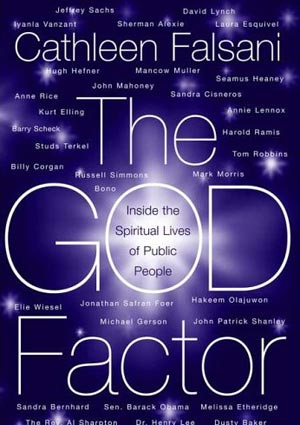
Over the course of five years, Chicago Sun-Times' religion writer Cathleen Falsani interviewed 32 well-known people—among them intellectuals, artists, political pundits and rockers—for her book, "The God Factor: Inside the Spiritual Lives of Public People." Subjects like Bono, Playboy founder and editor-in-chief Hugh Hefner and singer Annie Lennox all opened up to her questions about their individual faith and deeply held beliefs and doubts. Interference.com got to return the favor, asking her about the difference between religion and spirituality, how 9/11 impacted our faith, and even the similarity between church and a good U2 concert...more here
Subscribe to:
Posts (Atom)